The Algorithm That Sets Your Property Tax Is Probably Broken
3 shocking ways property tax calculations fail. How outdated CAMA algorithms produce systematic errors and what modern AI can do to fix assessment equity.
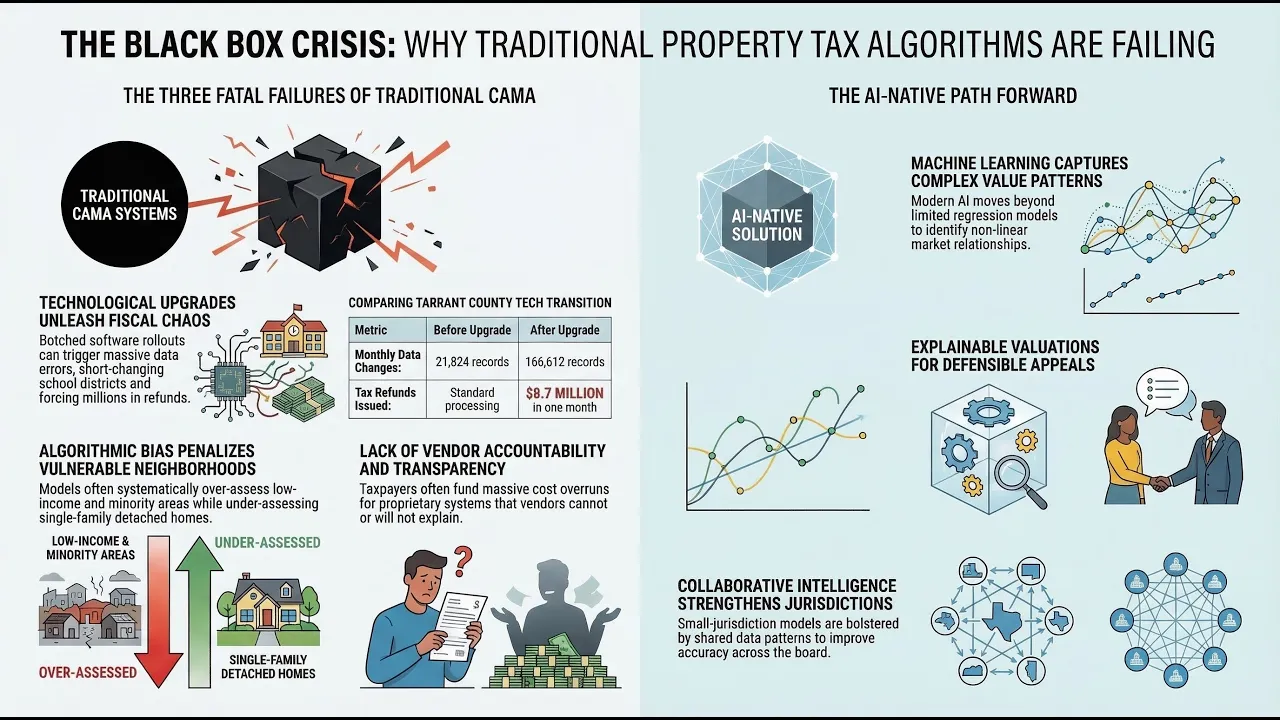
Key Takeaway: Traditional property tax algorithms rely on regression models trained on limited local sales data, producing wide confidence intervals and missing non-linear market relationships. Modern AI addresses this through machine learning that captures complex value patterns, Collaborative Intelligence that strengthens small-jurisdiction models, and Explainable Valuations that make every assessment defensible in appeals.
It arrives once a year, a plain envelope that can cause more anxiety than almost any other piece of mail: the property tax bill. For most homeowners, it’s a moment of quiet acceptance. You open it, you look at the number, and you trust that the figure is the result of a fair, accurate, and objective process. We assume that somewhere, a rational system has calculated the value of our biggest asset and determined our fair share for funding schools, roads, and public safety.
But that assumption of fairness rests on a shaky foundation. The valuation of your home is increasingly determined not by a person, but by a complex, often chaotic, technological system known as Computer-Assisted Mass Appraisal, or CAMA. This is the "black box" that translates your property into a tax liability. This article pulls back the curtain on that black box to reveal three of the most surprising and impactful ways these systems are failing taxpayers and local governments across the country.
Takeaway 1: Tech "Upgrades" Can Unleash Financial Chaos
When a county government announces a plan to modernize its decades-old property tax system, it sounds like a step toward efficiency. But as Tarrant County, Texas, discovered, a botched tech upgrade can unleash fiscal chaos on a massive scale. After using the same mainframe platform since 1980, the county’s appraisal district rolled out a new system, and the consequences were immediate and disastrous.
According to a Tarrant County Auditor’s report, the new software caused an explosion of data errors. The number of monthly data changes skyrocketed from an average of 21,824 records under the old system to an average of 166,612 with the new one. This explosion of data errors wasn't just a clerical issue; it directly distorted the tax rolls that fund public life. Because the system could no longer produce reliable valuations, the Eagle Mountain-Saginaw school district was shorted $5 million, forcing it to eliminate positions, while the valuation for the city of Fort Worth suddenly dropped by nearly $1 billion. Similarly, this data corruption triggered an "unprecedented" wave of erroneous tax bills, forcing the county to issue $8.7 million in refunds in a single month.
The failure reveals the shocking fragility of the systems that underpin local government finance, where a single technological breakdown can jeopardize funding for essential public services. And when local governments lack the in-house expertise to manage such complex transitions, they are often left at the mercy of the private tech vendors they hire to fix the problem—a relationship fraught with its own perils. The damage to public trust was so deep that the county auditor issued a grim forecast.
We believe it may be several years before the underlying TAD data will be relatively stable and reliable.
Takeaway 2: The Algorithms Have Hidden, Costly Biases
We tend to think of computers as objective, but the algorithms used in property assessment can perpetuate and even hide systemic inequality. This "algorithmic discrimination" occurs when a CAMA model systematically over-assesses certain types of properties and neighborhoods while under-assessing others. The result is an unfair and inequitable distribution of the tax burden, where the most vulnerable residents often pay more than their fair share.
The evidence for this is stark. An academic study of Philadelphia's CAMA system found clear patterns of systematic overassessment. The algorithm was found to disproportionately overvalue:
Specific property styles, such as row homes, semi-detached homes, and condos when compared to single-family detached homes.
Neighborhoods with lower median incomes.
Neighborhoods with higher percentages of Black and Hispanic populations.
This isn't an isolated issue. In Delaware, officials from Wilmington testified that homes in low-income neighborhoods shouldered steep tax increases after a recent reassessment. This problem is a modern, tech-driven version of a long-standing inequity. A 1995 report from Delaware’s The News Journal found that "especially the poorest homeowners - pay too much."
The financial burden of funding public services is not being shared equitably, and technology is helping to obscure that fact. The bias becomes harder to challenge because the algorithm provides a veneer of scientific objectivity. Homeowners are no longer arguing with a human assessor's judgment but with a million lines of proprietary code, making it nearly impossible for an ordinary citizen to prove the system itself is unfair. This lack of transparency and accountability often extends to the private companies that build and maintain these systems for governments.
Takeaway 3: Vendors Can Lack Transparency and Accountability
Local governments rarely build these complex systems themselves. Instead, they hire large, specialized technology firms like Tyler Technologies to manage the overhauls. But as jurisdictions from Cook County, Illinois, to the state of Delaware have discovered, these partnerships can become mired in delays, cost overruns, and a stunning lack of accountability, with taxpayers footing the bill. This dependency creates a recurring pattern across the country: whether through massive project delays in Illinois or a deliberate lack of transparency in Delaware, the result is a power imbalance that leaves taxpayers and public officials in the dark.
In Cook County, a series of projects with Tyler saw their collective costs swell from an initial estimate of $75 million to over $250 million. The county's property tax system overhaul, which began in 2015, was delayed by five years. Internal documents show a "merry-go-round" of Tyler project managers and letters from frustrated officials who considered firing the company, alleging that in one case, a calendar calculation was 73 years off. In Delaware, state legislators grilled Tyler Technologies representatives who were unable or unwilling to explain their valuation methodology, particularly for agricultural properties. When errors were identified, they were often corrected only for the specific property owner who complained, rather than being fixed system-wide.
This dynamic traps governments in what a Gartner consulting report for Cook County identified as a classic "sunk cost" bias—they continue to pour money into a failing project because they’ve already invested so much. The frustration of local officials is palpable.
...possibly the worst technology contract with a vendor that Cook County has ever written... an arrogant and disinterested vendor.
Ultimately, taxpayers pay for these failures twice: first in the massive cost overruns for the projects themselves, and again in the hidden costs of an inaccurate and inequitable tax system.
Conclusion: Demanding a Fairer Code
These failures are not isolated incidents; they are symptoms of a systemic breakdown. Botched rollouts create chaos, which obscures the algorithmic biases that quietly shift tax burdens, all while the specialized vendors who profit from these systems often evade meaningful accountability.
As government functions are increasingly handed over to code, the critical question becomes: who is auditing the algorithm, and how can we ensure it serves the public interest, not just the bottom line?
Read Next
Ready to see what AI-native assessment looks like? Let's talk about a pilot program for your jurisdiction.
By Cassie Vargas, Founder & CEO, CAMAai